Case Study · Eye & I On-Site
Cali Roots Quest 2026
Fifty missions, four tiers, one festival weekend in Monterey. The first ever Cali Roots Quest turned a crowd into players, and players into community.
Case Study · Eye & I On-Site
Fifty missions, four tiers, one festival weekend in Monterey. The first ever Cali Roots Quest turned a crowd into players, and players into community.
The California Roots Music and Arts Festival, Cali Roots XV, ran May 22 to 24, 2026 in Monterey, California. The Cali Roots Family is one of the tightest communities in live music: people travel solo to shows knowing they will find their people there. The Quest was built to complement the music, not compete with it: a reason to explore the grounds between sets, meet new people, and make the weekend your own.
The Cali Roots Quest was a festival-wide scavenger experience: 50 missions across 4 tiers, built to get people exploring the festival, discovering vendors and landmarks, and meeting each other. Explore. Connect. Capture the moment. The mission card promised endless memories, and the design was built so every mission produced exactly that: a photo or video that meant something to the person who took it.
The Quest was independently created and produced by Eye & I On-Site, built for the Cali Roots community and run with community support and festival amplification. It carried the festival's spirit and tags, and it was designed so future editions can fold in sponsors and partners as naturally as missions.
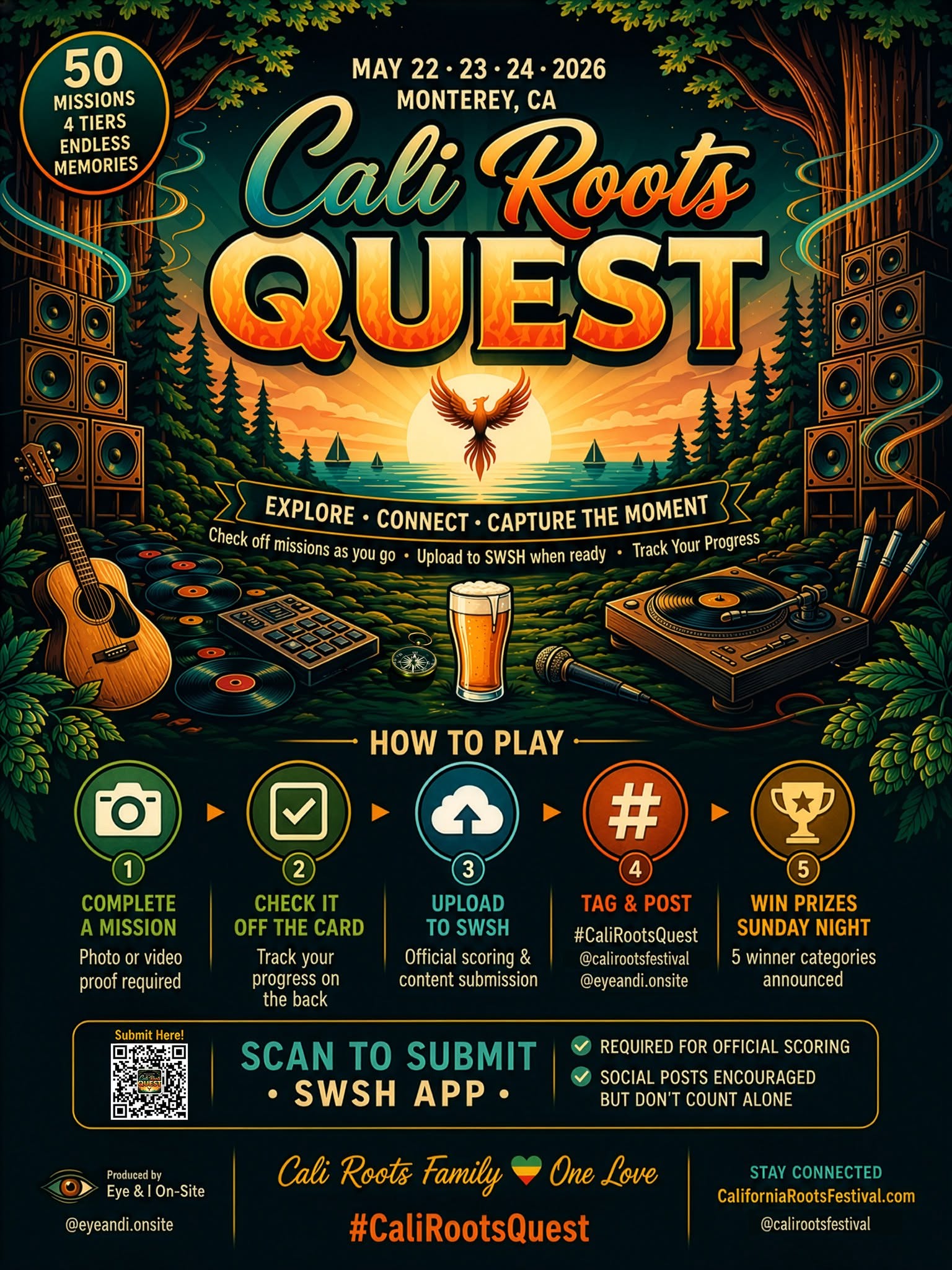
The Quest card: how to play, mission tracking on the back, QR submission via SWSH.
Photo or video proof required. Missions ranged across four tiers, so a family, a first-timer, and a festival veteran could all play at their own speed.
A physical mission card, tracked on the back. Analog on purpose: the card itself became a keepsake of the weekend.
Scanning the QR code on the card opened the SWSH app for official scoring and content submission. Digital where it counts, paper where it feels good.
#CaliRootsQuest, tagging @calirootsfestival and @eyeandi.onsite. Social posts were encouraged but did not count alone, which kept the game about doing, not just posting.
Winners announced in five categories on the festival's closing night, giving the whole weekend a finish line.
The Quest ran on a fully grassroots, DIY operation. Eye & I built an On-Site command center out of the campsite, a working production hub where the whole activation was run and kept evolving in real time across three festival days. From there the team printed QR codes, physical Quest cards, and Family Photo flyers on demand, made edits as needed, and adapted the game to how the weekend was actually unfolding rather than locking it in ahead of time.
Cards moved through the crowd the way the community moves: hand to hand and in person. The Saturday Family Photo meetup, before trivia, doubled as the Quest's ignition point. Holding up a single Quest Card and asking the crowd who recognized it turned near-universal recognition into a live onboarding moment: once people understood the game, they came up to grab physical copies and join in on the spot. Quest cards and Family Photo flyers posted around the venue kept pulling new players in throughout the weekend.
Submissions flowed through SWSH, where the shared album filled in across the weekend and gave the team a live read on participation. The activation was led by Angel Raygoza and Heather Bryan, and amplified organically by community friends including SoCal Street Team, Wax Goon, We Should Smoke, and Sean McCracken, whose reposts and word of mouth helped the Quest spread across the fairgrounds. What started as one idea became a running mix of scavenger hunt, community meetup, and experiential activation, held together from a single campsite table.
The first ever Cali Roots Quest ran the full three days, and participation outpaced what a one-weekend, grassroots pilot needed to justify itself. Players worked mission cards across the grounds, the shared SWSH album filled in throughout the weekend with everyone's different adventures, and winners in five categories were announced on closing night.
By the end of the weekend the Quest album had grown to 92 members and 199 uploaded photos, with 58 chats and comments and dozens of reposts and organic shares across the community. Beyond the counts, the album became a record of people meeting strangers and building little moments together around a shared prompt: the exact kind of connection and participation the Quest was built to encourage.
"Watching it organically grow into such a meaningful community experience was really special. The numbers and engagement speak for themselves. You guys absolutely crushed it!"
Three lessons for the next version. First, tiers work: four levels let everyone play without anyone feeling behind. Second, hybrid beats digital-only: the physical card gave the game a presence in people's hands that an app alone never has, while QR submission kept scoring honest and content flowing. Third, one person is the floor, not the ceiling: the response to a one-operator pilot suggests clear room to scale with dedicated staff, earlier promotion, and deeper event integration, and the mission framework is repeatable for any festival, venue, or community event that wants its crowd to become participants.
For Festivals, Promoters & Organizations
The framework scales from a brewery weekend to a three-day festival: missions built around your event, your sponsors, and your community. Tell us what you're planning.
Start the Conversation